
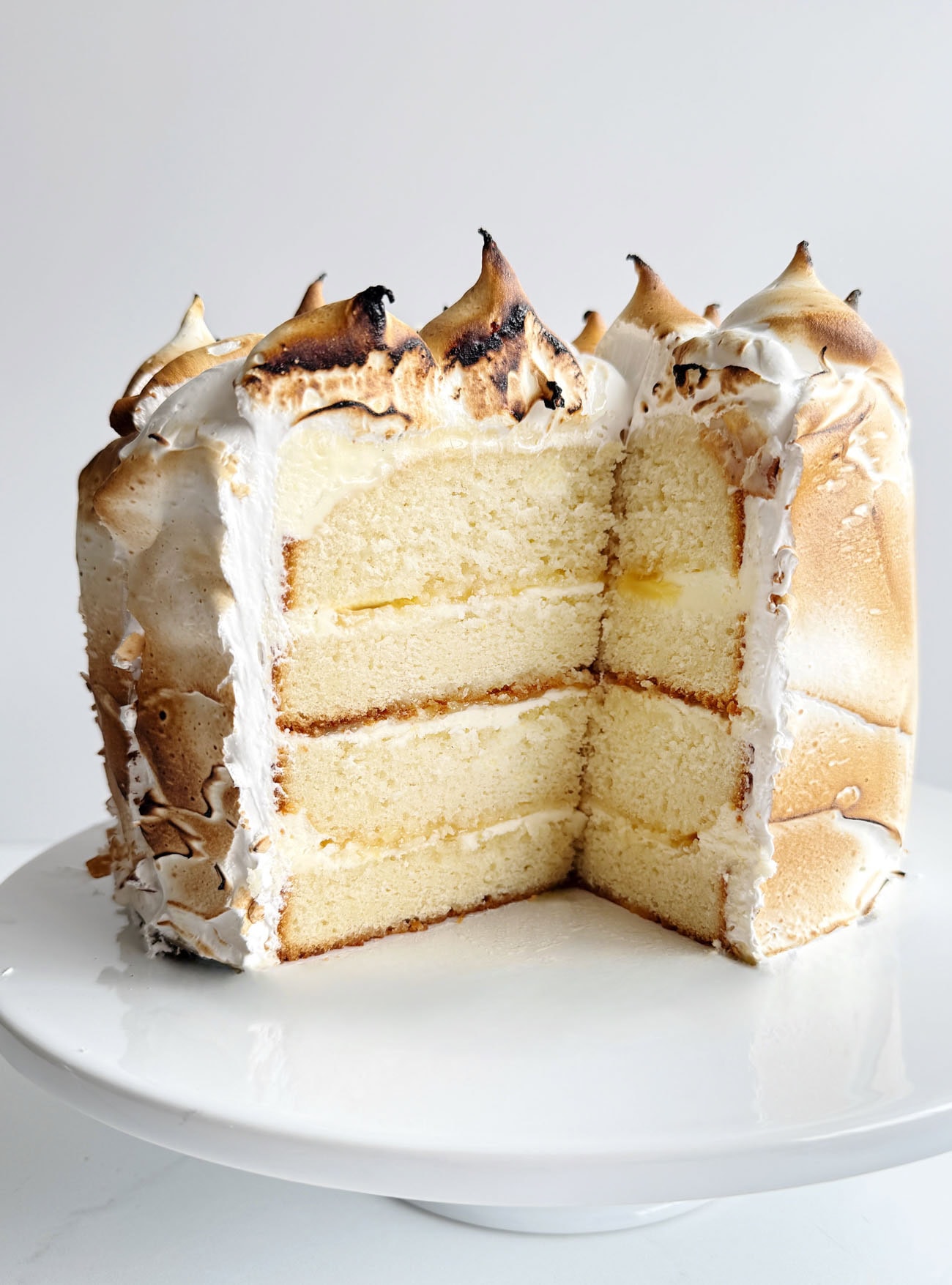
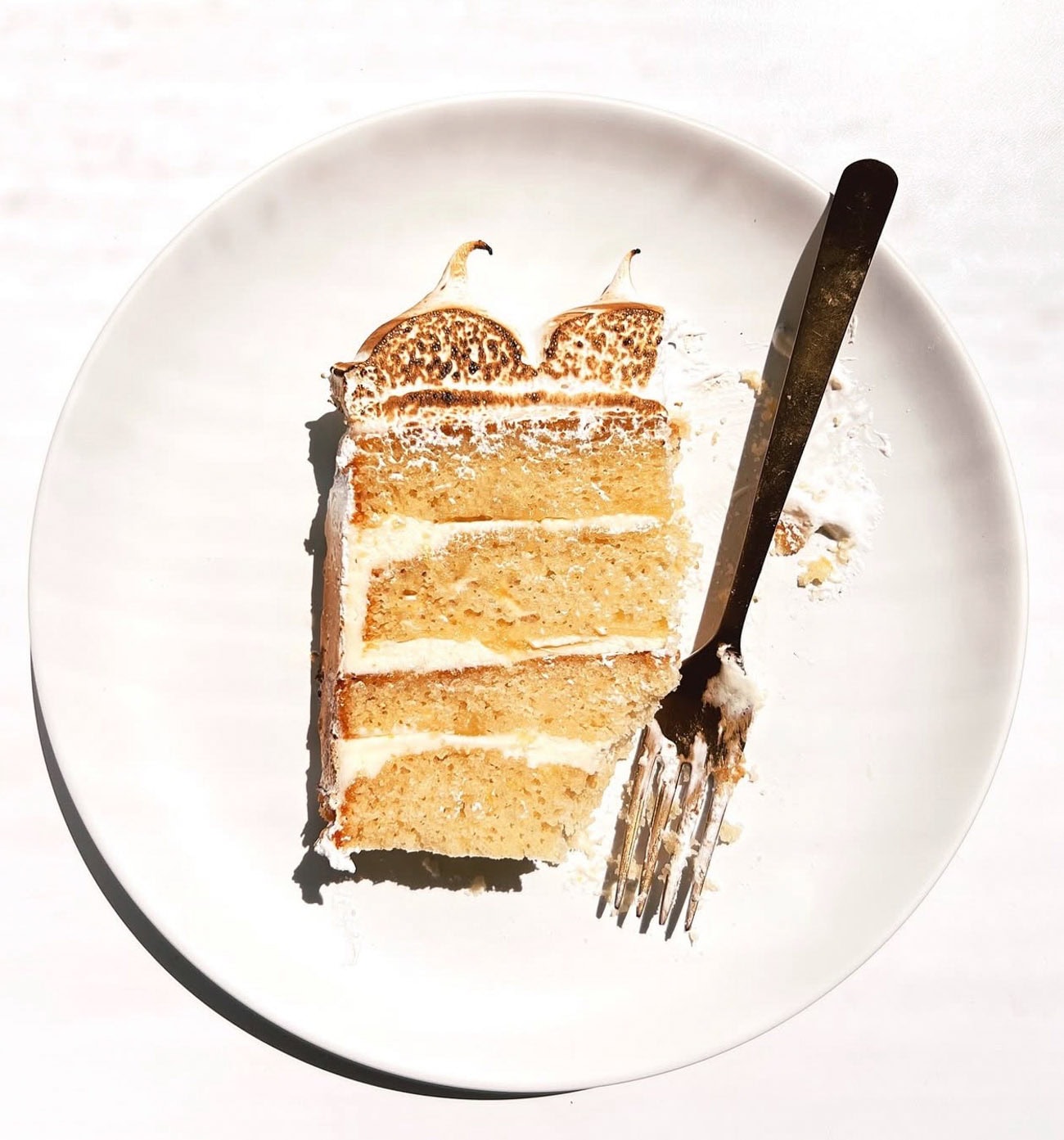
This is a re-vamp of the lemon meringue cake from my first book. My mother-in-law requested this cake for her birthday last year, and I changed a few things around with great results.
First, I swapped out the yellow cake base for white, and found that to be a big improvement. The white cake was lighter and more tender, and this worked well with the buttercream and meringue topping. I did keep the lemon soak, which adds a lot of great flavor, but I also added a lemon curd layer to bump up the lemon zing even more. It was truly one of the best cakes I have ever made, and now a yearly birthday request.
My Ingredient Notes:
- I love Vermont Creamery’s creme fraiche and use it in this recipe often. Sour cream works well, too!
- Because the egg whites aren’t being whipped for volume, store-bought egg whites will work here; just make sure that they are 100 percent liquid egg whites.
- I use Gold Medal unbleached all-purpose flour in this cake.
- You can make your own lemon curd, or buy some from the store. Just make sure it is a curd you have tried before and like; some brands are overly sweet or metallic tasting.
Why I Use the Reverse Creaming Method
I prefer the reverse creaming method for making cakes, where butter is introduced to the dry ingredients instead of initially creamed with the sugars. I prefer the texture of this type of cake over butter and sugar creamed cakes; it isn’t quite as fluffy, and has a very fine crumb that is even throughout. It works well for this reader favorite White Sprinkle Cake, too.
The top also doesn’t dome as much as a regular creamed cake, which I prefer for frosting purposes. I use this method for both yellow and white cakes.

Lemon Meringue Layer Cake
Ingredients
Cake
- 1 scant cup [210 g] large egg whites (from 6 or 7 eggs), at room temperature
- 1 cup [240 g] whole milk, at room temperature
- 1/2 cup [120 g] Creme Fraiche or sour cream, at room temperature
- 1 tablespoon pure vanilla extract
- 2 3/4 cups [391 g] all-purpose flour, plus more for coating the pans
- 2 cups [400 g] granulated sugar
- 4 teaspoons baking powder
- 1 teaspoon fine salt
- 1 cup [2 sticks or 227 g] unsalted butter, at room temperature, cut into 1 in [2.5 cm] pieces, plus more for greasing the pan
Soaking Syrup
- 1/3 cup [80 g] lemon juice
- 1/3 cup [65 g] granulated sugar
- Pinch fine salt
Lemon Buttercream
- 1 1/2 cups [3 sticks or 339 g] unsalted butter, at room temperature
- 3 tablespoons lemon juice
- 2 tablespoons corn syrup
- 1 tablespoon lemon zest
- Pinch salt
- 3 cups [360 g] confectioners' sugar
Meringue
- 2 cups [400 g] granulated sugar
- 1 cup [226 g] egg whites
- 1/4 teaspoon fine salt
- 1/4 teaspoon cream of tartar
- 1 tablespoon pure vanilla extract
Instructions
For the cake
- Adjust an oven rack to the middle of the oven and preheat the oven to 350F [180C]. Butter and flour two 8 by 2 in [20 by 5 cm] round cake pans and line the bottom with parchment paper.
- In a medium bowl or liquid measuring cup, whisk together the egg whites, milk, creme fraiche, and vanilla.
- In the bowl of a stand mixer fitted with a paddle, combine the flour, granulated sugar, baking powder, and salt.
- With the mixer running on low speed, add the butter one piece at a time, beating until the mixture resembles coarse sand. With the mixer still running on low, slowly add a little more than half the wet ingredients. Increase the speed to medium and beat until the ingredients are incorporated, about 30 seconds. Add the rest of the wet ingredients, mixing until just combined. Increase the speed to medium and beat for 20 seconds (the batter may still be a little bumpy). Use a spatula to scrape down the sides of the bowl and give the batter a couple of turns, making sure everything is completely combined.
- Divide the batter between the prepared pans and smooth the tops. Tap the pans gently on the counter twice to help get rid of any air bubbles. Bake for 30 to 38 minutes, rotating the pans halfway through, until the cakes are golden brown and a toothpick or wooden skewer inserted into the center comes out clean.
- Transfer the pans to a wire rack and let cool for 30 minutes. Turn the pans out onto the rack, remove the parchment paper, and let cool completely. Once cool, the cakes can be frosted or wrapped in plastic and refrigerated overnight. Unfrosted cakes can also be frozen for up to 2 weeks.
To Assemble the Cake
- Cut each cooled cake layer in half horizontally, to make a total of four layers. Place the layers cut-side up on two half sheet pans line with parchment.
For the soaking syrup
- Mix the lemon juice, sugar, and salt in a small saucepan and boil gently over medium-high heat until a light syrup forms, 5 to 7 minutes. Brush the warm syrup over the cake layers and let them cool while making the buttercream filling.
For the buttercream filling
- In the bowl of a stand mixer fitted with a paddle, beat the butter on medium speed until creamy. Add the lemon zest, lemon juice, vanilla extract, and salt, and mix on low until combined. Add the confectioners' sugar and mix until combined. Scrape down the sides of the mixing bowl, the beat again on low until the filling is very creamy and light, 5 to 8 minutes.
- Put one layer of cake cut-side up on a turntable or serving plate and top with 1/2 cup of the lemon buttercream. Use an offset spatula to smooth it out. Dollop the center with 3 tablespoons of lemon curd, and spread that evenly over the buttercream. Repeat this process with the second and third layers of cake, then top with the final layer of cake. Evenly coat the cake with the remaining buttercream. Chill the cake for at least 30 minutes and up to overnight (if chilling overnight, gently wrap the sides and top of the cake in plastic wrap once the buttercream has firmed in the refrigerator).
For the meringue
- In a medium saucepan over medium heat, bring 1 in [2.5 cm] of water to a gentle boil.
- Pour a few drops of lemon juice into the bowl of a stand mixer and use a paper towel to wipe the juice around the inside of the bowl (this helps remove any trace of grease, which can hinder the whites from whipping properly). Add the granulated sugar, egg whites, salt, and cream of tartar to the bowl and stir gently with a rubber spatula until completely combined.
- Place the bowl over the saucepan, being careful not to let the water touch the bottom of the bowl. Stir with the spatula until the sugar is completely dissolved and the mixture registers 160F [70C] on an instant-read thermometer, scraping down the sides of the bowl with the spatula, 4 to 5 minutes.
- Place the bowl in the stand mixer fitted with a whisk and whisk the the egg whites on low speed for 1 minute, until foamy. Slowly increase the speed to medium-high and beat for 8 to 10 minutes until stiff, glossy peaks form. The bowl should feel cool to the touch at this point. Add the vanilla and mix on low speed until combined. Use the meringue immediately.
To finish the cake
- Working quickly, use a spatula to spread the meringue over the sides and top of the cake in a thick layer. Once the cake is covered, you can even out the meringue and smooth the sides and make decorative curls on top, make curls over the entire body of the cake, or pipe as desired.
- Hold a kitchen blowtorch 1 to 2 inches away from the cake and touch the flame down in between the curls or other decoration. The meringue will toast and brown. Do this until you are happy with the color of the cake. This cake also tastes delicious un-torched, and can be served that way as well.
Notes


No Comments