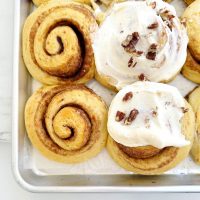
Soft Carrot Cake Cinnamon Rolls
These soft and fluffy cinnamon rolls have sweet carrots folded into the dough, with a cream cheese frosting on top and toasted pecans. Their gooey texture is unmatched, and each bite packed with flavor.
Servings 12 rolls
Ingredients
Sweet Dough
- 4 large eggs, at room temperature
- 3/4 cup [180 g] warm whole milk (100 to 110F [35 to 42C])
- 1/4 cup [85 g] honey
- 4 cups [568 g] all-purpose flour*
- 2 1/4 teaspoons instant yeast
- 2 teaspoons fine salt
- 10 tablespoons [1 1/4 sticks or 142 g] unsalted butter, at room temperature, cut into 1 in [2.5 cm] pieces
- 1 1/2 cups [150 g] finely grated carrots
Filling
- 3/4 cup [150 g] brown sugar
- 1 tablespoon ground cinnamon
- Pinch of ground cloves
- Pinch salt
- 2 tablespoons melted, unsalted butter
Icing
- 8 tablespoons [1 stick or 113 g] unsalted butter, room temperature
- 4 ounces [114 g] cream cheese, room temperature
- 1 teaspoon pure vanilla extract
- 1/4 teaspoon fine salt
- 1 cup [120 g] confectioners' sugar
Candied Pecans
- 1/2 cup [100 g] granulated sugar
- 1/4 cup [60 g] water
- 1/4 teaspoon fine salt
- 2 cups [280 g] toasted pecans
Instructions
For the dough
- Grease a large bowl.
- In a large liquid measuring cup, combine the eggs, milk, and honey.
- In the bowl of a stand mixer fitted with a paddle, mix the flour, yeast, and salt and stir on low to combine. Add the egg mixture and mix on low to combine. With the mixer on low, add the butter, one piece at a time. When all the butter has been added, increase the speed to medium and beat the butter into the dough, until all the little butter pieces are incorporated, 1 minute. Add the grated carrots and mix until well distributed. Transfer the dough to the prepared bowl. The dough will be very sticky and you will need a spatula to scrape the dough into the bowl.
- Cover the bowl with plastic wrap and let rise for 30 minutes. Place your fingers or a spatula underneath the dough and gently pull the dough up and fold it back over itself. Turn the bowl and repeat this folding again. Continue 6 to 8 more times, until all the dough has been folded over on itself. Re-cover the bowl with plastic and let rise for 30 minutes. Repeat this series of folding 3 more times, for a rise time of 2 hours and a total of 4 foldings. Tightly cover the bowl with plastic wrap and refrigerate overnight or up to 72 hours.
To assemble
- Flour a work surface and knead the cold dough 10 to 12 times (see troubleshooting above for why). Shape the dough into a ball, cover the top lightly with flour, and cover with a tea towel and let come to room temperature.
- Grease a 9 by 13 in [23 by 33 cm] pan; if desired, line with parchment paper (this makes for easier cleanup).
- In a small bowl, mix the brown sugar, cinnamon, cloves, and salt.
- Roll the dough into a 16 by 12 in [30.5 by 40.5 cm] rectangle. Brush the dough with the melted butter and sprinkle the cinnamon-sugar mixture evenly over the top, pressing it lightly into the butter so it adheres. Starting at a long side, roll the dough into a tight cylinder. Pinch the seam gently to seal it and position the dough seam side down. Use scissors or a sharp knife to cut the dough into 12 equal pieces. Transfer the pieces to the prepared pan and place them cut side up. Cover the pan loosely with plastic wrap and let the dough rise until doubled, 1 to 1 1/2 hours.
- Adjust an oven rack to the middle position. Preheat the oven to 350F [180C]. Remove the plastic and bake 27 to 32 minutes, rotating the pan halfway through, until the rolls are golden brown. While the rolls are baking, prepare the icing.
- Transfer the pan to a wire rack and let cool for 5 minutes. Using an offset spatula or table knife, apply a thin layer of the cream cheese icing, using about one-third of the mixture. Scatter the tops with candied pecans if desired. Let the rolls cool for another 15 to 20 minutes. Top with the rest of the icing and serve. Cinnamon Rolls are best eaten the same day they are made.
For the icing
- In the bowl of a stand mixer fitted with a paddle, beat the butter and cream cheese on medium until smooth and creamy. Add the vanilla and salt and mix on low to combine. Add the confectioners' sugar and mix on low until combined. Scrape down the sides of the bowl and mix on medium until the icing is light and fluffy, 3 to 4 minutes.
For the candied pecans
- Line a sheet pan with parchment paper.
- In a large skillet over medium heat, carefully stir together the sugar, water, and salt. Cook over medium heat until the sugar begins to melt and starts to turn golden. Shake the pan and add the nuts, stirring to completely coat. Remove from the heat and pour the nuts onto the prepared pan, then cool completely before chopping. The nuts will keep, in an airtight container at room temperature, for up to 1 week.
**For overnight cinnamon rolls
- Prepare the rolls (roll out dough, fill them, roll them up, cut them, and put them in the prepared pan, but do not let rise for 1 1/2 hours as stated above) then cover them loosely with plastic and refrigerate for up to 18 hours. When ready to bake, preheat the oven, and let the rolls sit at room temperature (still covered in plastic) for 30-45 minutes. Bake as directed (they make take slightly longer to bake).
Notes
The dough can be cut into 8, 10, or 12 pieces, depending on your preferred size. Add a few minutes to the baking time for larger-size buns.
You don’t have to use a 9 x 13-inch baking pan here; you can get creative if you’d like. I often use this round 10-inch pan for baking the cinnamon rolls or this 5 quart braiser. You could also bake them on a half sheet pan lined with parchment.
*** Throughout my recipes posted on this website, 1 cup of flour equals 142g. Please note that 1 cup of flour can range anywhere from 120g to 142g, depending on the baker or website. I found that after weighting many cups of flour and averaging the total, mine always ended up around this number. If I am posting a recipe from another cookbook, I will use whatever gram measure of flour used in that book, which is why you may see a few posts with a different cup measurement.
Different brands of flour have varying levels of protein, ranging from low to high, which can result in very different outcomes when baking. I’ve found Gold Medal all-purpose unbleached flour to be the best option for many of my recipes; I use it in all the baked goods that don’t use yeast. For yeasted doughs that call for all-purpose flour, I like to use King Arthur Brand.