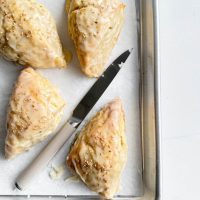
These flaky banana bread scones are soft and tender, packed with ripe banana flavor. They're finished with a nutty sesame icing while they're still warm, helping to keep them moist.
Servings 8 scones
Ingredients
- 1/2 cup [113 g] mashed bananas (about 1 1/2 bananas)
- 1/3 cup [80 g] heavy cream, plus more for brushing
- 1 large egg
- 1 teaspoon pure vanilla extract
- 2 1/4 cups [320 g] all-purpose flour, plus more for dusting*
- 1/3 cup [65 g] granulated sugar
- 1 tablespoon baking powder
- 1/2 teaspoon fine salt
- 12 tablespoons [1 1/2 sticks or 170 g] cold unsalted butter, cut into 1/2 in [12 mm] pieces
Sesame Icing
- 1 tablespoon unsalted butter, melted
- 1 to 2 teaspoons toasted sesame oil
- 1 teaspoon pure vanilla extract
- Pinch salt
- 1 cup [120 g] confectioners' sugar
- sesame seeds, for sprinkling
Instructions
For the scones
- Line a sheet pan with parchment paper. In a medium bowl or liquid measuring cup, whisk together the mashed bananas, heavy cream, egg, and vanilla. Refrigerate until ready to use.
- In a large bowl, whisk together the flour, granulated sugar, baking powder, and salt.
- Add the butter to the dry ingredients, and use a pastry cutter to cut in the butter until the flour-coated pieces are the size of peas. Add the refrigerated wet ingredients and fold with a spatula until just combined.
- Transfer the dough to a generously floured surface and knead ten to twelve times, until it comes together, adding a little flour as necessary (the dough will be sticky). Pat the dough into a square and roll it into a 12 in [30.5 cm] square, dusting with flour as necessary. Fold the dough into thirds, like a business letter. Fold the dough in thirds again by folding in the short ends, making a square. Transfer it to the prepared sheet pan and put it in the freezer for 10 minutes.
- Return the dough to the floured surface, shape it into a 12 in [30.5 cm] square, and fold the dough in thirds again. Turn over the dough, so it's seam-side down, and gently roll out the dough into a 12 by 4 in [30.5 by 10 cm] rectangle.
- With a sharp knife or bench scraper, cut the dough crosswise in to four equal rectangles, then cut each rectangle diagonally into two triangles, for a total of eight scones. Transfer the triangles to prepared sheet pan. Freeze the scones for 30 minutes, or up to two weeks.
- When ready to bake, position an oven rack to the middle of the oven and preheat the oven to 375F [190C].
- Brush the tops of the scones with a little heavy cream, making sure it doesn't drip down the sides. Place another sheet pan under the scones, so the pans are double-stacked (this helps prevent the bottoms of scones from browning too quickly). Bake the scones, rotating the stacked pans halfway through, until the tops and bottoms are light golden brown, 18 to 25 minutes. Transfer the top sheet pan to a wire rack and let the scones cool slightly.
For the toasted sesame icing
- While the scones are baking, in a small bowl, whisk together the melted butter, toasted sesame oil, vanilla, and salt. Add the confectioners' sugar and mix together, then whisk until well combined and smooth. If needed, add water, 1 tablespoon at a time, to reach the desired consistency. Use the back of a spoon to top each scone with the icing, then sprinkle with sesame seeds. The icing sets quick, so sprinkle the seeds right after icing each scone.
- Scones are best eaten the same day they are made.
Notes
*I like a lot of toasted sesame oil, so I used 2 teaspoons. If you aren't sure if you want that much, start with 1/2 teaspoon and taste the icing, and add more as needed.
* Throughout my recipes posted on this website, 1 cup of flour equals 142g. Please note that 1 cup of flour can range anywhere from 120g to 142g, depending on the baker or website. I found that after weighting many cups of flour and averaging the total, mine always ended up around this number. If I am posting a recipe from another cookbook, I will use whatever gram measure of flour used in that book, which is why you may see a few posts with a different cup measurement.
Different brands of flour have varying levels of protein, ranging from low to high, which can result in very different outcomes when baking. I’ve found Gold Medal all-purpose unbleached flour to be the best option for many of my recipes; I use it in all the baked goods that don’t use yeast. For yeasted doughs that call for all-purpose flour, I like to use King Arthur Brand.